News
What Wholesale Buyers in Congo (DRC / Republic of Congo) Ask First When Sourcing African Wax Print Fabric
Congo is two markets that face each other across one river.
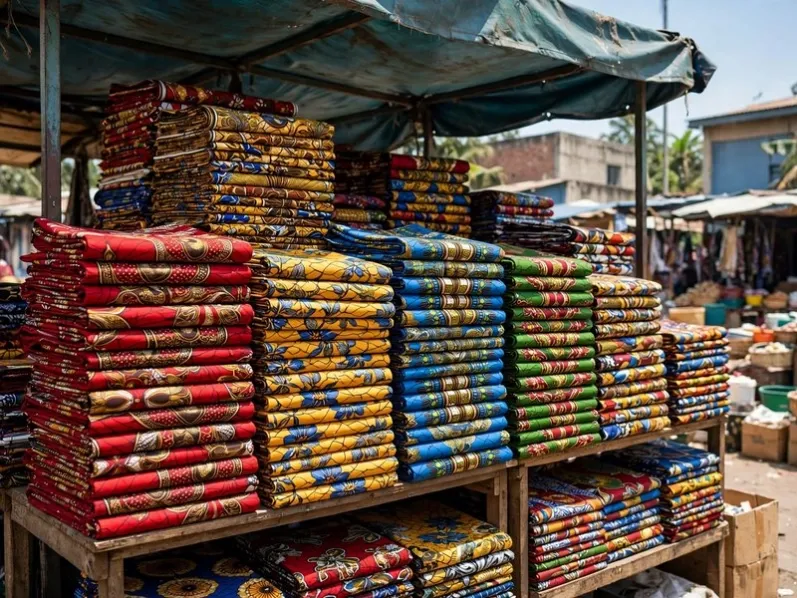
Congo is two markets that face each other across one river. Kinshasa, capital of the Democratic Republic of Congo, and Brazzaville, capital of the Republic of Congo, are the two closest capitals in the world, separated only by the Congo River — about 45 minutes by the official ferry. Printed textiles have long moved between them: academic research on the Brazzaville–Kinshasa trade describes Asian printed textiles arriving via Brazzaville for the Kinshasa market, and the 6-yard pagne remains the standard retail unit on both banks.
This article does not publish a price, a lead time, or a minimum order for ready designs. It answers the question wholesale buyers in Congo actually ask first, in the order they usually ask it — so an inquiry can be answered with a quotation instead of a round of clarifications. It builds on the site's earlier guides on finding a supplier, GSM and width, real wax print, packing, and cotton vs polyester, and applies those checks to one market. It does not repeat them.
- Which Congo, and which city?
Say which side of the river the fabric is for, and which city it will be sold in.
- Kinshasa (DRC) and Brazzaville (Republic of Congo) are different countries, different customs procedures, and different destination ports. A quotation for one is not a quotation for the other.
- Buyers in both cities work in French. The fabric is called pagne or tissu wax; "Ankara" is also understood, and Hollandais / Dutch wax is used for the premium cotton end of the range. Sending the inquiry in French, or with the French terms alongside the English, avoids the most common first misunderstanding: the buyer meaning one product and the supplier quoting another.
- State the destination city and port in the first message, not after the price. Freight, delivery terms and documentation all depend on it, and they cannot be confirmed from a design photo.
- Cotton or polyester — the first real question
This is the question that decides everything else, and it should be answered before design, price or packing is discussed.
- 100% cotton wax print is the cotton hand-feel option. On this site the confirmed cotton examples are 100% cotton, 135gsm, 46–47 inch width, two-side printing, 6-yard packing — but those figures belong to the specific products they are published on (for example the black-green fan-like, orange-pink floral and burgundy-navy geometric designs). They do not apply automatically to another design or to a custom order.
- 100% polyester wax print is the practical wholesale option, with broader design possibilities and different price levels. Single-sided or double-sided printing must be confirmed per product — do not assume it from the design.
- "Real wax", "authentic" and "original" are commercial descriptions, not specifications. A buyer who wants cotton should write "100% cotton"; a buyer who wants polyester should write "100% polyester". The material, the printing, the weight and the width are then confirmed product by product, in writing.
- Design: name it by its reference, not by its colour
"Blue wax" or "the flower one" can refer to several designs. Congo buyers usually buy by design family and colourway, so the inquiry should carry:
- how many designs, and how many colourways per design;
- the quantity per design, not only a total — a total of 6,000 yards spread over 20 designs is a different order from 6,000 yards of one design.
For custom designs, the confirmed minimums on this site are 6,000 yards per design for Cotton Wax and 12,000 yards per design for Polyester Wax. These are custom-order minimums. They are not packing lengths, and they are not automatic minimums for ready designs — the minimum for a ready design is confirmed per inquiry.
- The 6-yard pagne: packing is not the same as quantity
Six yards is the unit Congo buyers think in. A 6-yard piece is one pagne; it is also the packing length published for the confirmed cotton products on this site. Three things must still be kept separate:
- Packing length — 6 yards per piece, where confirmed for that product.
- Total quantity — yards per design and in total.
- Minimum order — confirmed per order, per design.
A 6-yard reference does not prove that six yards is the minimum order. Ask, in the same message, how the pieces are presented — folded, wrapped, labelled — and how many pieces go in a carton or bale, if that matters for resale. Retail prices seen in Brazzaville markets (a travel guide reports 6-yard wax pagnes at roughly 12,000–35,000 FCFA, with genuine Dutch wax up to about 90,000 FCFA) are retail prices in a local market. They are not wholesale prices and cannot be used to set a factory quotation.
- GSM and width, read as a set
Buyers in Kinshasa and Brazzaville cut for dresses, wrappers, headwraps and tailoring, so weight and width decide the yield — not the design alone.
- GSM is grams per square metre. Two fabrics can share a GSM and differ in material, construction and hand feel. GSM alone does not establish suitability, durability or price.
- Width is the crosswise dimension. Ask whether the quoted width is the full width or the usable cutting width after selvedges, and whether the motif placement affects cutting.
- Read material, GSM, width, printing and packing together, attached to one product reference. For the cotton examples on this site that set is: 100% cotton, 135gsm, 46–47 inch, two-side printing, 6-yard packing. For any other product, ask for its own set — do not carry these figures across.
- Samples: check the fabric, not only the photo
A photo proves the design. It cannot prove material, weight, width, printing method, colourfastness or stock. Before a bulk order, agree in writing:
- which product reference the sample corresponds to;
- what to check on it — material and hand feel, colour against the approved reference, print on both sides where two-side printing is claimed, measured width, and packing;
- whether approval of the sample is sample-only or extends to the order specification.
Do not treat a sample discussion as a certified test result, and do not assume a fixed sample lead time or cost — both are confirmed per inquiry.
- What to send in the first inquiry — a checklist
Send this in one message, in French or in English with the French terms included:
- Destination: Kinshasa or Brazzaville, and the port / delivery terms requested.
- Material: 100% cotton or 100% polyester.
- Product links or design references, designs per order, colourways per design.
- Quantity per design and total quantity.
- Packing: 6-yard pieces, and any labelling, folding or carton questions.
- Intended use: resale, garment making, retail programme, or other.
- Sample requirement, and what should be confirmed on the sample.
- Open questions: availability, price, minimum order, lead time, payment terms — listed as questions to be confirmed, not assumed.
A short brief in this form gets a usable quotation back. A message that only asks "Do you supply real wax print fabric?" cannot — "real" is not a specification.
Kinshasa and Brazzaville buy the same 6-yard pagne, in the same French, across the same river — but they are two destinations, and every quotation depends on which one, which material, which design reference, and how many yards of each. Send the checklist above and the quotation can be prepared from it.
Price, availability, lead time, payment and delivery terms are confirmed per inquiry, against the exact product reference and quantity. Nothing in this article publishes a fixed price or lead time.
Version française — résumé
À Kinshasa comme à Brazzaville, le pagne de 6 yards reste l'unité de référence. Avant de demander un prix, précisez : coton 100 % ou polyester 100 %, la référence du motif, la quantité par motif, la destination (Kinshasa ou Brazzaville) et l'emballage souhaité. Le prix, le minimum de commande et le délai sont confirmés pour chaque demande, produit par produit.