African Wax Fabric Packing: 6 Yards, 12 Yards and 600 Yards Explained for Wholesale Buyers
When importers, wholesalers, distributors, fabric retailers, and garment manufacturers compare African wax print fabric, packing descriptions such as 6 yards, 12 yards, and 600 yards often appear

When importers, wholesalers, distributors, fabric retailers, and garment manufacturers compare African wax print fabric, packing descriptions such as 6 yards, 12 yards, and 600 yards often appear beside material and design information. These numbers look simple, but they should not be treated as a complete packing specification. A buyer still needs to confirm what the number refers to, how the goods will be presented, and how the quoted quantity connects to the final shipment.
This guide explains how to read those packing references during sourcing. It uses confirmed entries in the AfricanPrintWax product records, while avoiding the assumption that every design, material, or order is available in every listed format. Packing options vary by product and order requirement, so each inquiry should confirm the exact product, material, length, unit structure, quantity and destination.
A published 100% cotton wax design with confirmed 6-yard packing: Product ID27. Packing should still be confirmed for the exact product and inquiry.
What does a 6-yard packing reference tell a buyer?
A 6-yard reference identifies the stated length associated with a particular product record. It does not, by itself, confirm the outer packaging, number of pieces in a carton, labeling, shipment configuration, or total order quantity.
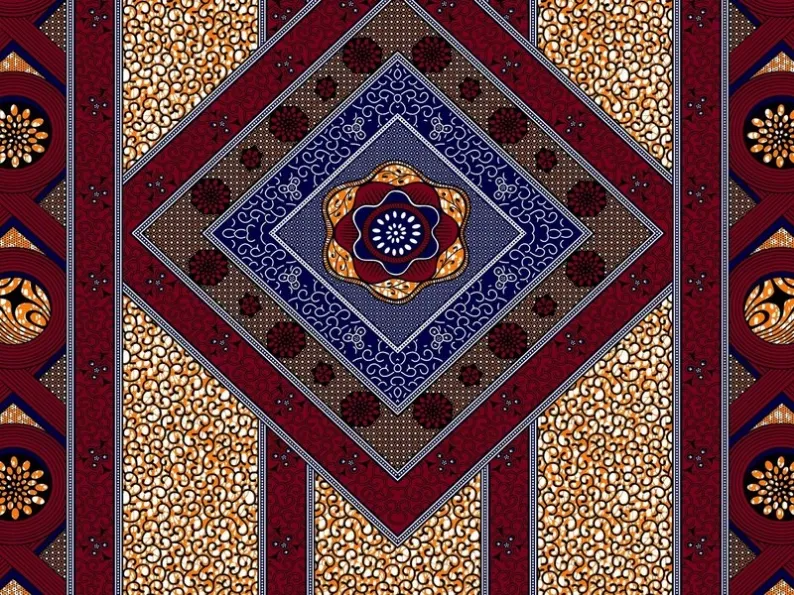
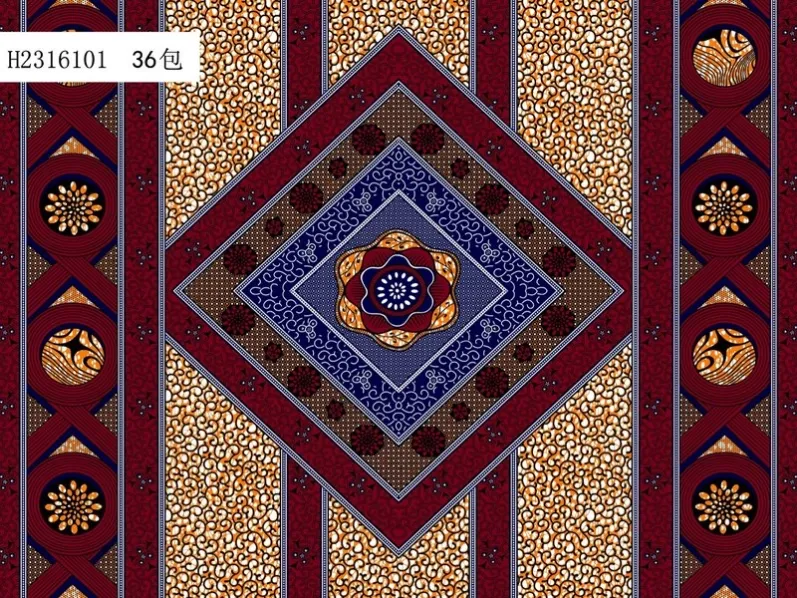
The current AfricanPrintWax Cotton Wax batch records 6-yard packing for its approved products. Published examples include the black-and-green fan-like design on Product ID27, the orange-and-pink floral design on Product ID28, and the burgundy-and-navy geometric design on Product ID29. These examples support the 6-yard wording for those exact product records. They should not be used as proof that an unrelated design automatically has the same packing.
For a retailer, a 6-yard reference can help organize product identification and downstream presentation. For a garment manufacturer, the important next step is to compare the stated length with the planned cutting requirement. Neither buyer should assume usable yield from length alone: fabric width, motif scale, placement, and the buyer’s own cutting plan also need to be reviewed using confirmed information.
How should buyers interpret 12-yard references?
The current product inventory includes specific African wax fabric listings whose titles contain 12-yard packing wording. For example, Product ID19 is a Cotton Wax listing whose current title uses 6Y/12Y/600Y Packing. That makes 12 yards a valid reference for that listed product record, but not a universal promise for every Cotton Wax or Polyester Wax design.
When a buyer requests 12 yards, the inquiry should name the exact product URL or design reference. The buyer should then ask whether 12 yards describes one presented unit, a combined quantity, or another order-specific arrangement. This distinction matters because the number alone does not define folding, wrapping, labeling, or carton details.
If a sourcing team plans to compare 6-yard and 12-yard options, it should request the same set of written facts for both: material, width, fabric weight when relevant, printing or finish description, packing unit, number of units, and total quantity. Comparing only the headline yardage can create a false equivalence between products with different confirmed specifications.
What should buyers verify when they see 600 yards?
Some existing AfricanPrintWax product titles, including Product ID19, include 6Y/12Y/600Y Packing. In procurement terms, the 600-yard wording signals that a larger quantity reference exists in those specific product records. It does not confirm how 600 yards are divided, packed, labeled, or shipped, and it does not establish a minimum order quantity.
A buyer considering a 600-yard reference should ask for a written quantity breakdown. The request should identify the chosen material and designs, the yardage expected for each design or colorway, the required presentation, and the destination country. The supplier can then confirm what arrangement applies to that inquiry.
This is especially important for assortment orders. “600 yards” could be misunderstood if the buyer and supplier are using different assumptions about design count or unit structure. The safe approach is to replace a single total with a line-by-line schedule before approval. No general packing label should substitute for that order document.
Packing length is not the same as MOQ
Buyers should keep three concepts separate:
- the stated length associated with a product or packing reference;
- the total quantity requested across all designs;
- the minimum quantity the supplier can confirm for the actual order.
A 6-yard product reference does not prove that six yards is the MOQ. In the same way, a 600-yard reference should not be interpreted automatically as a fixed MOQ. Price, MOQ, availability, and lead time must be confirmed for the exact design, quantity, packing request, and destination. AfricanPrintWax does not use these article references to publish fixed commercial terms.
Build a packing confirmation sheet before ordering
A short confirmation sheet helps purchasing, sales, and receiving teams work from the same information. For each selected product, record:
- the formal product URL and design reference;
- confirmed material and product type;
- stated packing length;
- number of units and total yardage requested;
- design or colorway allocation;
- width and fabric weight if they affect the purchase decision;
- folding, wrapping, labeling, or carton requirements that need confirmation;
- destination country and shipping instructions;
- open questions about availability, MOQ, price, and lead time.
Do not copy an earlier order’s packing assumptions into a new order without confirmation. A different design, material, quantity, or destination can require a different discussion. Photographs can help identify a design or show visible presentation, but they cannot prove the complete packing specification.
Questions to send with a wholesale inquiry
A precise inquiry is easier to evaluate than a message asking only for “6 yards price” or “600 yards wax.” Include the product link, material required, selected designs, quantity per design, total quantity, intended use, destination, and requested packing presentation. If labels or other order-specific details matter, list them separately and ask whether they can be discussed for the order.
Buyers can start with the African print wax product category and then share the formal URLs of the designs they want to discuss. For broader sourcing guidance, How to Choose African Wax Print Fabric for Wholesale Orders explains the main product-selection questions, while Cotton vs Polyester African Wax Print Fabric: A Wholesale Buyer’s Guide supports material comparison.